
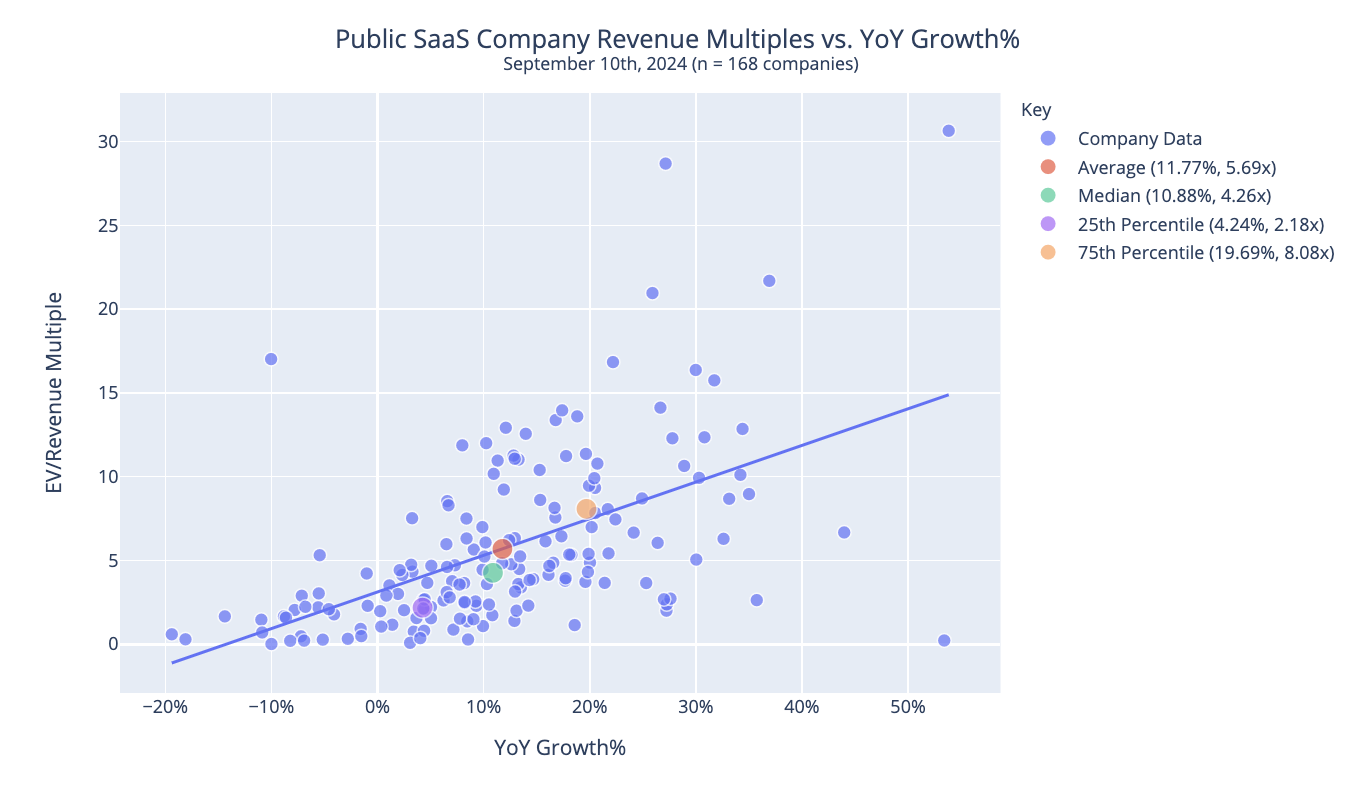
The software-as-a-service (SaaS) industry has seen huge growth over the past two decades, with over 170 SaaS businesses currently listed on the U.S. stock exchanges NYSE and NASDAQ, with many more having been publicly listed at some point in the past.
We have compiled a comprehensive, free database of almost all public SaaS companies on NYSE and NASDAQ, providing users with the information needed to understand and monitor growth, profitability, valuations, and more when analyzing either the whole Public SaaS space or individual SaaS companies. In this post, we’ll delve into the key metrics that matter when examining SaaS businesses and how to apply them.
Understanding Key SaaS Metrics
The key metrics we will discuss are vital in evaluating SaaS businesses. These metrics not only provide insights into a company’s performance but also its future potential. Let’s dive into each of these key metrics.
Recurring Revenue and Growth
The first metric to consider is recurring revenue, which is the main feature of a SaaS business model. Oracle currently has the highest recurring of any public SaaS company, at over $57B. This is the primary reason why oracle market cap is also the highest in the SaaS world at roughly $370B. This metric includes subscription fees, maintenance fees, and other periodic charges that a SaaS company earns from its customers on a recurring basis, typically monthly or annually. Recurring revenue is a measure of a company’s stability and predictability in generating income.
To examine a company’s growth, look at the growth rate of its recurring revenue. A higher growth rate signifies a rapid expansion and demand for products/services. It’s important to keep in mind that the growth rate is only one side of the story, and customer retention and acquisition costs are also important.
Customer Churn and Retention
Churn rate shows the percentage of customers canceling their subscriptions or failing to renew their contracts over a given period. A high churn rate indicates a loss of potential revenue and may also raise questions about product relevance or quality.
On the other hand, customer retention is the inverse of churn rate. It represents the percentage of customers who stay with the company over time. A high customer retention rate means that a company has loyal customers.
To get a well-rounded outlook, examine the churn and retention rates together. This way, you can have a clearer picture of how well a SaaS company maintains its customer base while growing.
Customer Acquisition Cost (CAC)
In SaaS, CAC plays a crucial role in determining the company’s profitability and financial sustainability. CAC is calculated as the total sales and marketing expenses divided by the number of new customers acquired within a given period.
A low CAC implies that a company efficiently attracts new customers with minimal expense, indicating good marketing practices and product-market fit. Conversely, a high CAC suggests that a company is spending too much to acquire customers, which can negatively impact its bottom line. Comparing CAC with other metrics such as recurring revenue growth and the lifetime value of a customer can be useful in assessing the effectiveness of a company’s customer acquisition strategy.
Lifetime Value (LTV) of a Customer
This metric measures the total revenue that a business can expect to generate from a customer over their entire relationship, but usually a 3 to 10 year period is used for this calculation. To calculate LTV, consider factors such as customer retention rate, average deal size, and gross margin percentage.
A high LTV indicates that customers are likely to generate significant revenue over time, thus justifying the investment in customer acquisition. A higher ratio of LTV to CAC (LTV/CAC) indicates a better return on investment, which is a positive sign for the financial health and growth potential of a SaaS company.
Gross and Operating Margins
Gross margin measures the percentage of revenue remaining after subtracting the cost of goods sold (COGS). A high gross margin indicates that a SaaS company can generate a healthy profit while covering its expenses. In the SaaS industry, the cost of goods sold mainly includes expenses related to providing and maintaining the software, such as hosting, licensing, and customer support expenses. Data and infrastructure costs may also be included.
Operating margin goes a step further by considering operating expenses, such as S&M, R&D, G&A. It gauges the efficiency of a company’s operation, measuring how much money is left after covering the day-to-day operating costs.
Conclusion
When evaluating SaaS businesses on NYSE and NASDAQ, understanding key metrics like recurring revenue, customer churn, retention, customer acquisition cost, lifetime value, and gross and operating margins is crucial. These metrics can provide valuable insights into a company’s performance, financial health, and potential growth. By analyzing these metrics, one can better evaluate SaaS companies and the SaaS industry as a whole.
For more insightful content on SaaS investing, bookmark our page, and stay ahead of industry trends and analysis tailored for those interested in the thriving world of SaaS investing. Explore PublicSaaSCompanies.com today for more information and metrics.
Leave a Reply